
Drainage Deep French Drain Systems
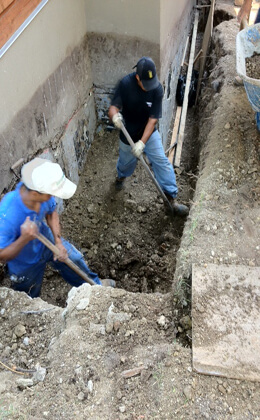
A standard French drain intercepts water moving through the top 12–18 inches of soil. In most yards, that’s enough. In Austin, it often isn’t.
Central Texas properties frequently have drainage problems that originate deeper — below the shallow clay layer, along the limestone interface, or from subsurface hydrostatic pressure that a shallow trench never reaches. When a standard French drain fails to solve the problem, or fails after installation, a deep French drain system is usually why.
Austin Drainage + Landscape Development has designed and installed deep French drain systems in Austin since 1984. This page explains what makes a system “deep,” when depth is required, and how we approach deep installations differently in Central Texas conditions.
What Is a Deep French Drain System?
A deep French drain operates on the same principle as a standard French drain — a gravel-filled trench with perforated pipe that intercepts and redirects water — but is installed at significantly greater depth, typically 3 to 6 feet below the surface rather than the standard 12 to 18 inches.
The greater depth allows the system to intercept water moving through lower soil horizons, relieve hydrostatic pressure building up against foundation walls, and reach discharge elevation in sites where shallow grade makes gravity drainage impossible at the surface.
When to Use a Deep French Drain
Depth is required when the water source is deeper than a standard installation can reach. Specific situations where we specify deep systems in Austin:
Foundation Hydrostatic Pressure
When water accumulates in the soil around a foundation and can’t escape, it creates hydrostatic pressure — a lateral force pushing against foundation walls that causes cracking, bowing, and long-term structural damage. A shallow French drain intercepts surface and near-surface water but doesn’t relieve pressure building up at footing depth. A deep system installed at or below footing elevation intercepts the water before it reaches the foundation wall.
Water at the Clay-Limestone Interface
Austin’s typical soil profile is clay over limestone. When water percolates through the clay layer and hits the limestone surface, it moves laterally along the interface rather than continuing downward. This lateral flow can travel significant distances before surfacing — often against a foundation or in a low spot well away from the water source. A deep French drain installed to the limestone surface intercepts this flow at the interface where it’s actually moving.
Shallow-Grade Sites with Limited Surface Fall
Standard French drains require sufficient surface grade to discharge by gravity. On flat properties or sites where the discharge point is close to the same elevation as the problem area, there isn’t enough fall to move water through a shallow system. A deeper trench creates additional elevation differential, allowing gravity discharge on sites that would otherwise require a sump pump.
Failed Shallow Systems
If a French drain has been installed and still isn’t solving the problem, depth is often the reason. Shallow systems that don’t reach the actual water movement horizon have no effect on the underlying drainage problem regardless of how well they’re built. We frequently assess previously installed systems and find the water source is 2–3 feet below where the pipe was placed.
Deep French Drain Installation in Austin’s Soil Conditions
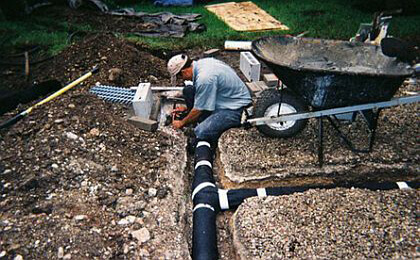
Deep installations in Austin present specific challenges that don’t apply in other markets:
Limestone Encounter Depth
Many Austin properties hit limestone at 18–36 inches. Excavating through limestone requires different equipment and adds time and cost. We assess limestone depth during the site visit — properties where limestone is at or near the target depth need a modified approach, which may include blasting, mechanical rock removal, or a redesigned system depth.
Trench Stability in Expansive Clay
Deeper trenches in Austin’s expansive clay require more careful management of trench walls. Clay that’s wet when excavated can collapse or shift before the gravel and pipe are placed. We schedule deep installations to avoid wet conditions and work in sections to maintain trench integrity throughout installation.
Schedule 40 PVC at Depth
At depth, pipe rigidity matters more than in shallow installations. Soil pressure at 4–6 feet is significantly higher than at 12–18 inches. We use Schedule 40 PVC for all French drain installations — at depth, the difference between rigid PVC and corrugated pipe is even more pronounced. Corrugated pipe at foundation footing depth will compress under soil load and lose flow capacity within a few years.
Deep French Drains vs. Sump Pumps
When gravity discharge isn’t feasible, the alternative to a deep French drain is an exterior sump pump system — a collection basin that stores water and pumps it to a discharge point. Both solutions work; the right choice depends on the site.
Deep French drains are passive — no electricity, no mechanical components, no maintenance beyond inspection. Sump pumps require power, regular maintenance, and fail if the power goes out during the storm that causes the flooding. Where gravity discharge is achievable with a deep installation, we prefer it.
In some Austin properties, the answer is both — a deep French drain that intercepts subsurface flow and directs it to a sump basin, which then pumps to a remote discharge point. → Learn more about our sump pump systems
How We Assess Whether You Need a Deep System
We determine required depth during the free site visit. Key factors we evaluate:
- Water entry point — where exactly is water entering the problem area, and at what depth
- Soil profile — clay depth, limestone surface elevation, and soil permeability at different depths
- Existing system performance — if a shallow drain is already installed and failing, what depth would intercept the actual flow
- Discharge options — what elevation differential is available and whether deep installation enables gravity discharge
- Foundation proximity — if the problem is hydrostatic pressure, footing depth determines target pipe elevation
We don’t specify deep systems to upsell. They cost more to install and take longer. We specify them when the water problem is deeper than a shallow system can address — which in Austin’s geology is more common than most markets.
Deep French Drain FAQs
How deep is a deep French drain?
Typically 3 to 6 feet, compared to 12 to 18 inches for a standard system. The target depth is determined by where water is actually moving in the soil — usually the clay-limestone interface or foundation footing elevation, whichever is relevant to the problem being solved.
Does depth make a French drain more expensive?
Yes. More excavation, more gravel, more pipe, and more labor. In Austin, limestone at depth can add equipment cost for rock removal. Deep installations run 30–60% more than comparable shallow systems. Where depth is required, a shallow system at lower cost won’t solve the problem — so the comparison isn’t really shallow vs. deep, it’s deep vs. no solution.
Can a deep French drain be added next to an existing shallow one?
Yes. If a shallow system is already installed but not solving the problem, we can install a deeper system alongside it or replace the shallow one. The existing shallow drain may actually still be useful if it’s capturing near-surface flow — in some cases both systems run in parallel addressing different water horizons.
How long does a deep French drain installation take?
Most residential deep French drain installations take two to three days depending on scope, limestone conditions, and trench length. Properties requiring rock removal may take longer.
Get a Free Deep French Drain Assessment
If you’ve had drainage work done that didn’t solve the problem, or if you have foundation moisture that surface drainage hasn’t addressed, depth is likely the issue. Call (512) 453-4932 or fill out our contact form to schedule a free on-site assessment.
We serve Austin, Westlake, Cedar Park, Round Rock, Pflugerville, Kyle, and Buda.
Austin Drainage + Landscape Development — Austin’s most experienced drainage contractor since 1984.