
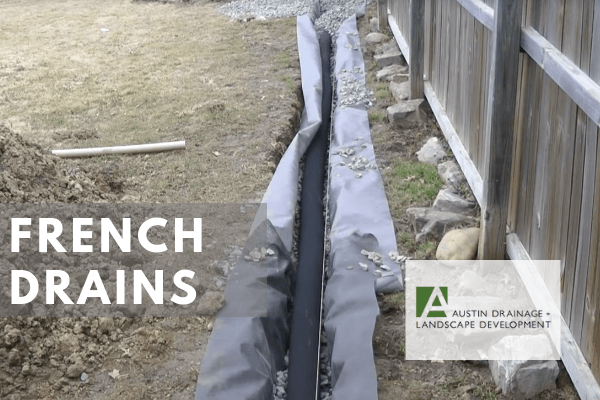
French drains are the most reliable solution for chronic yard flooding in Austin — and also the most commonly botched. A well-installed French drain with the right materials lasts 30+ years without intervention. A poorly installed one, or one with cheap pipe, fails within a decade and needs to be dug up and replaced entirely.
We’ve been installing French drains in Austin since 1984. This guide covers everything a homeowner needs to know before calling a contractor: how they work, when they’re the right solution, what they cost in Central Texas, and the one material decision that determines how long the system lasts.
What Is a French Drain?
A French drain is a gravel-filled trench containing a perforated pipe buried below the surface. Water seeps into the trench through the gravel and pipe perforations, then flows downhill through the pipe to a designated discharge point — typically a street, drainage easement, or dry well.
The name has nothing to do with France. It comes from Henry Flagg French, a Massachusetts farmer who described the system in his 1859 book on farm drainage. The design is simple, passive, and proven — no moving parts, no electricity, no ongoing maintenance beyond occasional inspection.
How French Drains Work
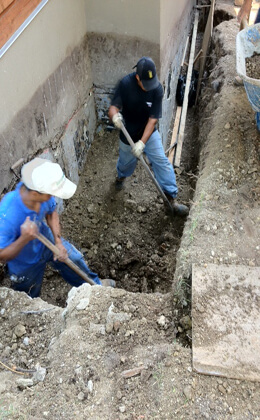
Water follows the path of least resistance toward the lowest available point. A French drain creates an artificial low point by burying a perforated pipe in a gravel-lined trench below the problem area. When rain falls or groundwater rises, water moves into the trench rather than pooling on the surface or saturating the soil.
The pipe carries water by gravity to the discharge point. This is why grade — the slope of the pipe — is critical. French drain pipe needs a consistent minimum fall of 1% (1 inch per 10 feet) to keep water moving. Flat or improperly graded pipe creates standing water inside the system, which eventually backs up and defeats the purpose entirely.
At the discharge end, water exits through a pop-up emitter, open pipe end, or into a dry well depending on the site conditions and how much volume the system handles.
When You Need a French Drain
French drains solve specific drainage problems. They are not the right solution for every situation — but they are the right solution for these:
- Standing water in the yard that takes more than 24 hours to drain after rain
- Soggy, perpetually wet areas where grass won’t grow
- Water pooling near the foundation or seeping against the house
- Runoff from a slope or hill flowing toward the house or low area
- Water migrating from a neighboring property into your yard
- Wet basement or crawlspace caused by subsurface water pressure
French drains address subsurface and sheet-flow water. If your primary problem is roof runoff from downspouts, a downspout collection system is a better fit — or both systems together for complete coverage.
Why Pipe Material Determines How Long Your French Drain Lasts
This is the most important thing in this guide. Most homeowners don’t ask about pipe material. Most contractors don’t volunteer it. And it’s the reason the majority of French drain systems in Austin need replacement within 10 years.
Corrugated Pipe: The Industry Standard That Fails
The vast majority of French drains installed in Austin use corrugated plastic pipe — flexible, lightweight, and cheap. It’s the default because it’s easy to work with and cuts contractor time significantly.
Corrugated pipe fails in two ways in Central Texas conditions:
- Silt and root intrusion. The corrugated ridges trap fine particles and create anchor points for root growth. Over time, the pipe clogs and backs up. In Austin’s clay soil, this happens faster than in sandier environments.
- Collapse under soil movement. Austin’s expansive clay expands when wet and contracts when dry — sometimes dramatically across a single season. Corrugated pipe can’t sustain repeated compression cycles and eventually collapses, blocking flow entirely.
Schedule 40 PVC: What We Use
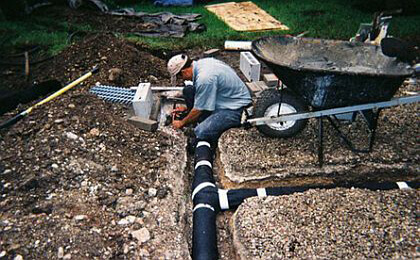
We install all French drains with Schedule 40 PVC — rigid, smooth-walled pipe used in permanent plumbing installations. It doesn’t flex, doesn’t compress, and the smooth interior gives roots and silt nothing to grab onto.
Schedule 40 PVC costs more and takes longer to install than corrugated pipe. It also outlasts corrugated systems by 20+ years in Austin’s clay soil. We’ve replaced dozens of failed corrugated systems installed by other contractors. We’ve never had to replace one of our PVC systems due to pipe failure.
French Drains in Austin’s Specific Soil Conditions
French drain design in Central Texas isn’t the same as in other parts of the country. Three local factors change how a system needs to be built:
Expansive Clay Soil
Austin’s black and gray clay soils have high shrink-swell potential — one of the highest in the country. Pipe must be rigid enough to withstand repeated soil movement. Trench depth and gravel backfill must account for the fact that the surrounding soil will move.
Limestone Bedrock
Many Austin properties hit limestone within 18–24 inches of the surface. This limits excavation depth and affects where water can realistically discharge. In some cases it means rethinking the entire system design — a sump pump may be needed where gravity discharge isn’t possible.
Flash Flood Rainfall
Austin gets most of its annual rainfall in short, intense bursts rather than slow steady rain. A French drain designed for typical regional rainfall averages will be undersized for a Central Texas storm event. We size pipe diameter and discharge capacity for peak storm volume, not average rainfall.
How Much Does a French Drain Cost in Austin?
French drain cost in Austin varies by scope, but here are realistic ranges for residential projects:
- Single problem area (50–100 linear feet): $2,500–$5,000
- Full yard drainage system (French drain + area drains): $5,000–$12,000
- Complex systems (multiple discharge points, sump integration, large property): $12,000–$20,000+
Corrugated pipe installations cost less upfront. Schedule 40 PVC costs more. Over a 20-year period, a PVC system almost always costs less because it doesn’t need to be replaced.
We offer free on-site estimates. A site visit takes about 30 minutes and gives us everything we need to quote accurately — we don’t quote over the phone because the grade, soil, and discharge options on your property determine the price more than the linear footage alone.
French Drain Installation: What to Expect
A professional French drain installation follows these steps:
- Site assessment — we evaluate grade, soil conditions, water source, and discharge options before any digging.
- Design — pipe diameter, trench depth, discharge point, and gravel specification are determined based on your specific site.
- Excavation — trench is dug to the designed depth and grade. Utility lines are located before any digging.
- Pipe and gravel installation — pipe is laid on a gravel bed, perforations oriented correctly, and covered with gravel and filter fabric.
- Discharge installation — pop-up emitter, open end, or dry well installed at the discharge point.
- Restoration — trench is backfilled, surface grade restored, and area seeded or sodded as needed.
Most residential installations take one to two days. The yard is fully functional immediately after.
French Drain FAQs
How long does a French drain last?
A French drain installed with Schedule 40 PVC and proper grade lasts 30+ years with minimal maintenance. Corrugated pipe systems in Austin’s clay soil typically need replacement within 10 years.
Do French drains require maintenance?
Very little. We recommend an annual inspection of the discharge point to confirm flow is unobstructed. PVC systems are largely maintenance-free. Corrugated systems require more frequent inspection for root intrusion and silt buildup.
Can I install a French drain myself?
The trench and gravel can be DIY’d. Proper pipe grade, discharge point selection, and pipe sizing require professional assessment. An improperly graded French drain creates standing water inside the pipe and accomplishes nothing. In Austin, limestone depth and clay movement make professional design more important than in most markets.
Will a French drain fix my wet basement?
It depends on the water source. French drains address subsurface water migrating through the soil toward your foundation. If the basement moisture is caused by roof runoff from downspouts, a downspout collection system is the primary fix. Many wet basements need both.
How deep should a French drain be?
Depth depends on the water table, limestone depth, and the specific problem being solved. Foundation relief drains are typically 18–24 inches deep. Yard drainage drains vary based on grade and discharge point. We determine correct depth during the site visit — there’s no universal answer.
Does a French drain need a permit in Austin?
Most residential French drain installations don’t require a permit in Austin. Installations that discharge to the street or connect to storm infrastructure may require city notification. We handle all permitting questions as part of the project.
Get a Free French Drain Estimate
Call (512) 453-4932 or fill out our contact form to schedule a free on-site estimate. We’ve been installing French drains in Austin since 1984 — longer than any other drainage contractor in Central Texas.
We serve Austin, Westlake, Cedar Park, Round Rock, Pflugerville, Kyle, and Buda.